


Syllabus: GS2/Governance
Context
- A professional agency has revealed that regulated data, including patient records and medical information, is especially at risk, accounting for 89% of all data policy violations occurring in the area of generative AI usage.
Use of AI in Healthcare
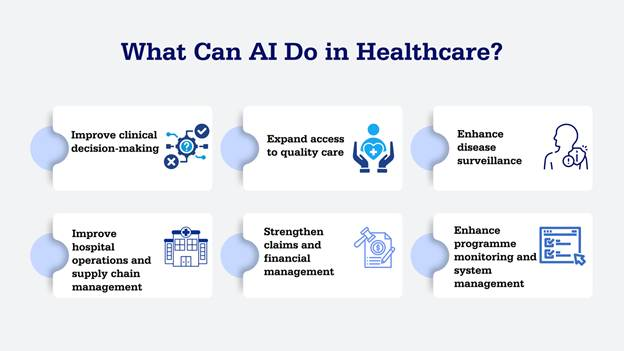
- AI-based tools can diagnose and predict diseases, streamline clinical practices, improve hospital management, assist in drug discoveries and aid in healthcare research.
Indian Council of Medical Research (ICMR’s) four priorities for AI in Health
- Collating quality data across research institutions.
- Forging private sector partnerships.
- Generating real-world evidence through ICMR’s network of institutes.
- Urgently integrating health and medical professionals into the AI workforce pipeline.
Arguments in Favour of use of AI in Healthcare
- Improved Diagnostic Accuracy: AI can analyse large medical datasets and imaging scans quickly, helping doctors detect diseases at an earlier and more accurate stage.
- Enhanced Efficiency and Time Saving: AI automates routine tasks like medical record management, scheduling, and data analysis, allowing healthcare professionals to focus more on patient care.
- Personalised Treatment: AI can analyse genetic information, lifestyle data, and medical history to develop tailored treatment plans for individual patients.
- Early Disease Prediction and Prevention: AI models can identify patterns in health data and predict potential diseases, enabling preventive healthcare and timely interventions.
- Improved Drug Discovery and Research: AI accelerates the process of drug discovery and clinical trials by analysing complex biological data, reducing time and cost in developing new medicines.
- Better Healthcare Accessibility: AI-powered telemedicine and virtual health assistants can extend healthcare services to remote and underserved areas, improving access to medical care.
- Support in Public Health Management: AI helps governments and health organisations analyse large datasets for disease surveillance, outbreak prediction, and policy planning.
Arguments Against
- Risk of Data Leakage through AI Prompts: Healthcare workers may unknowingly include patient details in prompts or uploaded documents while using Generative AI tools, leading to exposure on external servers.
- Use of Personal Accounts: Many employees use personal AI tools or cloud accounts instead of secure institutional systems, making it difficult for organisations to monitor or prevent data breaches.
- Growing Cybersecurity Threats in Healthcare: The healthcare sector is already a prime target for cybercriminals, and increased digitalisation and AI integration further expand the attack surface.
- Lack of Awareness and Training: Healthcare staff may lack adequate cybersecurity training, increasing the chances of unintentional data exposure.
- Regulatory and Ethical Concerns: Breaches of patient data can violate data protection laws and ethical obligations of medical confidentiality, undermining trust in healthcare systems.
India’s AI-Health Policies
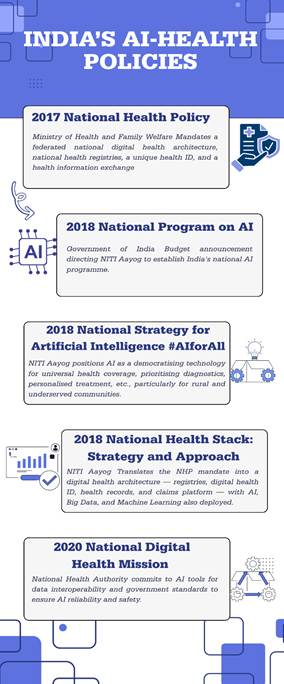
- Strategy for AI in Healthcare for India (SAHI): SAHI works as a recommendatory national framework on the way AI can be integrated into healthcare services.
- Launched as a national framework, SAHI outlines a structured roadmap for integrating AI into healthcare delivery across India.
- BODH (Benchmarking Open Data Platform for Health AI): It was launched during the AI Summit, provides a structured mechanism for testing and validating Health AI solutions before deployment at scale.
- It was developed by the Indian Institute of Technology Kanpur in collaboration with the National Health Authority.
Source: TH
Next article
News In Short 06-03-2026
